
About arc42
arc42, the template for documentation of software and system architecture.
Template Version 8.2 EN. (based upon AsciiDoc version), January 2023
Created, maintained and © by Dr. Peter Hruschka, Dr. Gernot Starke and contributors. See https://arc42.org.
1. Introduction and Goals
1.1. Requirements Overview
The project aims to develop a full-stack web application for a game named YOVI, communicating human players and automated agents. The following high level specifications must be in the final version of the application:
1.1.1. User Management
| ID | Description |
|---|---|
FR-01 |
The system must allow users to register and authenticate (login/logout) to manage their personal profiles. |
FR-02 |
The system must maintain a persistent history of matches played by each registered user. |
FR-03 |
The system must provide a profile for users to view their statistics, including win/loss ratios and total games played. |
1.1.2. Gameplay (Web Frontend)
| ID | Description |
|---|---|
FR-04 |
The frontend shall implement the "Classic Version" of Game Y in a Player-vs-Machine (AI) mode. |
FR-05 |
The system shall support variable board sizes, allowing the player to define the dimensions before starting a match. |
FR-06 |
The UI shall allow the player to select from multiple game strategies or difficulty levels provided by the AI. |
FR-07 |
The frontend shall visualize the board using the coordinate systems (Barycentric or Index-based) defined in the YEN notation. |
1.1.3. Game Engine (Rust Module)
| ID | Description |
|---|---|
FR-08 |
The module shall provide a web service interface to receive game states and return move calculations. |
FR-09 |
The engine shall validate the current board state to determine if a match has been won, lost, or is still in progress. |
FR-10 |
The engine shall implement at least two distinct move-generation strategies for the AI. |
1.1.4. External Bot API
| ID | Description |
|---|---|
FR-11 |
The API shall expose a |
FR-12 |
The API shall provide endpoints for bots to retrieve user information and historical game data. |
FR-13 |
The API shall support parameters for bots to specify which game strategy the engine should utilize during a match. |
1.1.5. Data & Communication
| ID | Description |
|---|---|
FR-14 |
All communication between the TypeScript frontend and the Rust backend shall be conducted via JSON messages. |
FR-15 |
The system shall strictly adhere to the YEN notation for representing board layouts, player turns, and piece positions. |
1.2. Quality Goals
| Goal | Description |
|---|---|
Availability |
The application and its API must be publicly accessible and maintain high uptime for both web users and bot integrations. |
Usability |
The frontend should be intuitive, allowing users to easily toggle between game strategies and view their statistics without a steep learning curve. |
Performance |
The backend architecture should handle concurrent matches from both web users and API-based bots without significant latency. |
Security |
User data and match histories must be protected via secure authentication, ensuring users can only manage their own profiles. |
The top three (max five) quality goals for the architecture whose fulfillment is of highest importance to the major stakeholders. We really mean quality goals for the architecture. Don’t confuse them with project goals. They are not necessarily identical.
Consider this overview of potential topics (based upon the ISO 25010 standard):
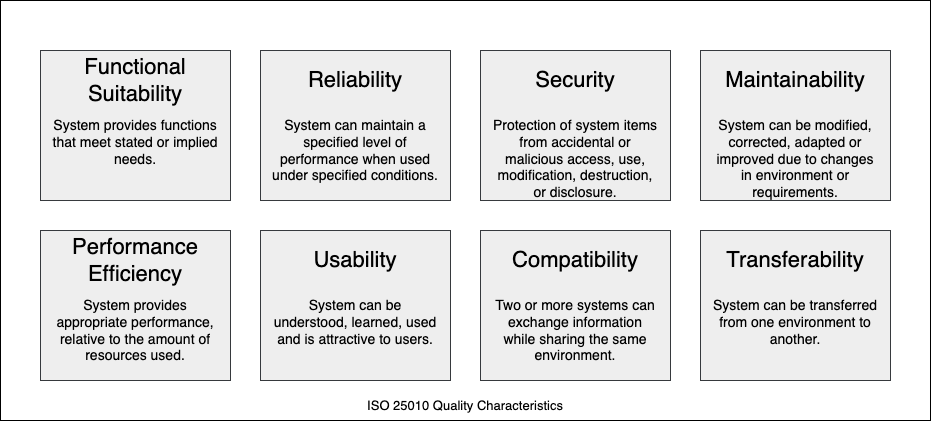
You should know the quality goals of your most important stakeholders, since they will influence fundamental architectural decisions. Make sure to be very concrete about these qualities, avoid buzzwords. If you as an architect do not know how the quality of your work will be judged…
A table with quality goals and concrete scenarios, ordered by priorities
1.3. Stakeholders
| Role/Name | Contact | Expectations |
|---|---|---|
Development team |
yovi_en1a |
To receive clear requirements and timely feedback on builds. |
Players |
N/A |
To get an engaging application of the game that is stable and intuitive. |
Evaluators |
Archisoft |
To ensure the architectural integrity between the frontend (TypeScript) and backend (Rust) via the YEN notation. |
Micrati |
N/A |
To receive a functional prototype that meets all predefined success criteria. |
2. Constraints
2.1. Technical Constraints
Technical constraints define the specific technologies and tools that must be used.
| Constraint | Description |
|---|---|
Programming Languages |
Frontend must be TypeScript. The core Game Y logic (win verification/suggestions) must be Rust. |
Data Exchange |
All subsystem communication must use JSON formatted according to the YEN notation (size, turn, players, layout). |
Deployment & Runtime |
The system must be containerized with Docker and run on an Ubuntu Linux environment. |
External Connectivity |
The system must expose a documented Web API accessible by third-party bots for automated gameplay. |
2.2. Architectural Constraints
Architectural constraints are the high-level design requirements that dictate the system’s structure.
| Constraint | Description |
|---|---|
Subsystem Decoupling |
The system must be split into at least two distinct subsystems (Web App and Rust Module). They must remain independent and communicate only via web services. |
Strategy Extensibility |
The architecture must support multiple AI strategies and difficulty levels, selectable by the user or the bot via the API. |
Multi-Coordinate Support |
The system must handle both Barycentric (x,y,z) and Index-based (0…n) coordinate systems, ensuring correct mapping between the UI and the Engine. |
2.3. Organizational Constraints
Organizational constraints relate to the project management and academic requirements.
| Constraint | Description |
|---|---|
Academic Framework |
Must satisfy all criteria for the ASW assignment, including traceability and quality attributes. |
Team Workflow |
Mandatory use of Git for version control, featuring documented Code Reviews and Issue Tracking. |
Documentation Standard |
Architecture must be documented using the arc42 template and include Architectural Decision Records (ADRs). |
Evaluation Metrics |
The system must be evaluated on Availability and Observability (Monitoring) and Testing Coverage. |
2.4. Conventions
Conventions are the rules agreed upon by the team to ensure consistency.
| Convention | Description |
|---|---|
Language |
English is the mandatory language for code, documentation, and the API. |
API Documentation |
All endpoints must be fully documented. |
Modeling |
Diagrams must follow UML standards and be rendered using software such as PlantUML. |
Naming Conventions |
Follow standard TypeScript (camelCase) and Rust (snake_case) style guides respectively. |
3. Context and Scope
Our Game Y system is a distributed gaming platform designed to provide a competitive environment for both human players and automated agents. The system’s primary boundary lies between the user-facing web interface and the high-performance game logic engine implemented in Rust.
3.1. Business Context
The business context defines how YOVI interacts with external entities. The system acts as a standardized provider for both human players and third-party bots, ensuring interoperability through the YEN notation.
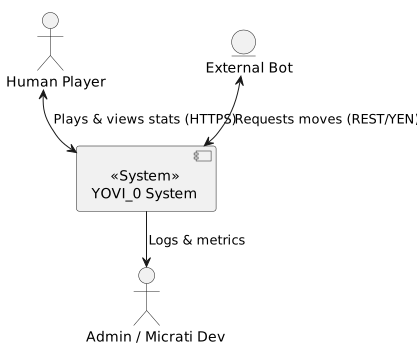
| Communication Partner | Inputs | Outputs |
|---|---|---|
Human Player |
Account registration data, game moves via hexagonal UI, and selection of AI strategy. |
Real-time board updates, personal performance statistics, and historical match records. |
External Bots |
RESTful API requests containing current board states in YEN notation. |
Calculated next moves in YEN notation and game-state validation. |
Micrati Developers / Admins |
Infrastructure configuration, CI/CD scripts, and Docker management. |
Application health metrics, observability logs, and test coverage reports. |
External Domain Interfaces:
-
YEN Notation: The primary domain language. It is a JSON-based representation ensuring interoperability between any external subsystem.
-
Coordinate Systems: Supports both Barycentric (x,y,z) and Index-based coordinates to accommodate different mathematical approaches by bot developers.
3.2. Technical Context
The YOVI_0 architecture follows a microservices-inspired model. All communication between the React-based frontend and the specialized services is handled over network calls.
| Interface | Protocol | Description |
|---|---|---|
Client Browser |
HTTPS / TCP |
The entry point for the user. Delivers the React SPA, which subsequently handles business logic via fetch/axios. |
Internal Services |
HTTP / JSON |
Communication between the Webapp, the Node.js User Service (Port 3000), the Node.js GameY API Gateway (Port 3001), and the underlying Rust GameY Engine (Port 4000). |
Public Bot API |
REST / JSON |
A public endpoint allowing third-party applications to interact with the game engine using the YEN standard. |
Mapping Input/Output to Channels:
-
Game Logic Flow: Move submissions from the Webapp or external bots are sent via JSON POST to the GameY API Gateway (Node.js). The gateway acts as a proxy, forwarding the YEN payload to the Rust Engine, which validates the move and returns the updated state back through the gateway.
-
Authentication Flow: Credentials are sent via HTTP POST to the User Service, which processes the persistence simulation and returns a status code.
-
Observability: Logs from Node.js and Rust are mapped to standard Docker output (
stdout), accessible via the technical management console.
4. Solution Strategy
4.1. Technology Decisions
The system architecture bridges mandated technical constraints with strategic choices focused on security, internationalization, and performance.
| Decision | Technology | Motivation |
|---|---|---|
Database |
MongoDB |
Fits the YEN Notation (JSON) format naturally and allows for flexible player statistics without rigid schemas. |
Hosting |
Microsoft Azure (VM) |
Selected for robust management and seamless GitHub Actions integration, utilizing "Azure for Students" credits. |
Backend API |
Node.js (Express) |
Implemented as |
Authentication |
JWT (Stateless) |
Allows services to verify user identity locally, reducing network latency and decoupling the service landscape. |
Security |
bcrypt |
Ensures secure password hashing before persistence in MongoDB, protecting user credentials against rainbow table attacks. |
Globalisation |
i18n |
Implemented to support multiple languages within the React frontend, ensuring accessibility for a global player base. |
4.1.1. Testing & Documentation Strategy
| Decision | Technology | Motivation |
|---|---|---|
API Docs |
OpenAPI / Swagger |
Provides a machine-readable contract at |
UI Testing |
Playwright |
Ensures complex hexagonal grid interactions remain functional across all browser engines. |
End-to-End |
Cucumber |
BDD-style verification of full game flows (login → move → win) for business logic consistency. |
Load Testing |
Gatling |
Validates that the Node/Rust stack can sustain high concurrent traffic. |
4.2. Top-level Decomposition
The system follows a microservices-oriented approach to ensure a clean separation of concerns:
-
Webapp (React): The presentation layer. It utilizes i18n for localization and translates UI interactions into YEN-compliant API calls.
-
User Service (Node.js): The identity provider (Port 3000). Uses bcrypt for secure credential storage and issues signed JWTs.
-
Game API (gameyapi - Node.js): The core orchestrator (Port 3001). A RESTful service managing active sessions and coordinating the flow between the UI and the logic engine.
-
Logic Engine (Rust): The computational core (Port 4000). A stateless service optimized for grid validation and AI calculations.
4.3. Achievement of Quality Goals
| Quality Goal | Strategy for Achievement |
|---|---|
Availability |
Resilient Middleware & Hosting: Implementing a custom DB health check in the User Service to auto-reconnect to MongoDB and deploying on Azure VMs to ensure the API remains reachable for both users and bots. |
Usability |
Internationalization (i18n): Integrating |
Performance |
Functional Offloading: Isolating CPU-intensive hexagonal grid logic and AI move generation in a dedicated Rust module. This prevents the Node.js event loop from blocking, maintaining low latency for concurrent matches. |
Security |
Data & Identity Protection: Utilizing bcrypt for securing user credentials at rest and JWT for stateless authorization, ensuring users can only manage their own profiles and access their specific match histories. |
5. Building Block View
The Building Block View provides a hierarchical decomposition of the YOVI_EN1A system. It describes the static structure, showing how the system is organized into subsystems and components, and how they interact with each other. This view is essential for understanding the overall architecture and the responsibilities of each part of the system.
5.1. Level 1: Overall System
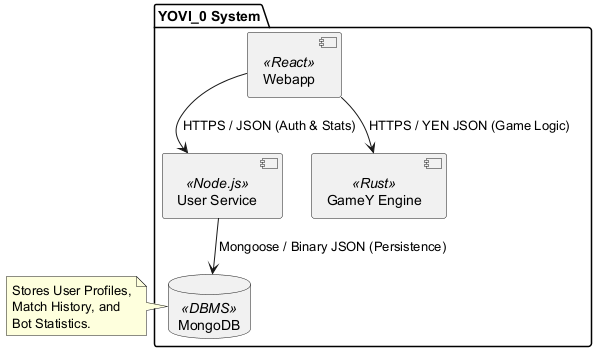
Level 1 represents the highest level of abstraction, showing the main subsystems of the YOVI_EN1A system and their interactions. Each subsystem is responsible for a specific aspect of the system’s functionality, and they communicate with each other to fulfill the requirements of the project.
The following diagram shows the top-level decomposition of the YOVI_EN1A system into its four primary subsystems: the Frontend (Webapp), the User Management (User Service), the API Gateway (GameY API), and the Logic Engine (GameY).
5.1.1. Component Descriptions
| Name | Responsibility |
|---|---|
Webapp |
The central UI and gateway. Manages hexagonal grid rendering and provides the documented API for external bots. |
User Service |
Handles administrative logic: user registration, session management, and persists match statistics to the DBMS. |
GameY API Gateway |
A Node.js proxy serving as the public REST API. It handles route management and passes JSON payloads to the underlying Rust engine. |
GameY Engine |
The high-performance "brain." Written in Rust for memory safety and speed; it validates game rules and provides AI moves via YEN notation. |
MongoDB |
The Document-based DBMS. It persists all non-transient data, chosen for its native support of JSON-like structures (perfect for YEN payloads). |
5.2. Level 2: Webapp (Frontend Subsystem)
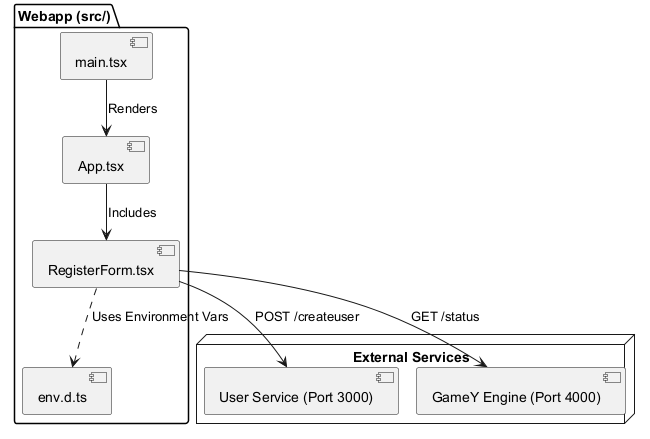
The Webapp is a Single Page Application (SPA) built with React and Vite. It acts as the primary user interface and the orchestrator of requests between the User Service and the GameY API Gateway.
5.2.1. Component Descriptions
| Component | Detailed Responsibility |
|---|---|
main.tsx |
The Bootstrap of the application. It utilizes the react-dom/client library to find the root element in the HTML and injects the React application. It implements StrictMode to identify potential problems during development. |
App.tsx |
The Navigation Orchestrator. Reads URL query parameters (?view=) to render the correct view: RegisterForm, Lobby, GameBoard, or Profile. Manages logout and navigation between views. |
RegisterForm.tsx |
On success, stores the JWT token in localStorage and triggers navigation to the Lobby via URL parameters. |
Lobby.tsx |
The Game Configuration Hub. Allows users to select mode (PvP/PvC), difficulty (Beginner/Medium/Advanced), board size (5-15), and game rule (Classic/Why Not/FortuneY). |
GameBoard.tsx |
The Core Gameplay Component. Renders the hexagonal board, manages live sessions via the GameY API, handles moves, bot responses, undo, rematch, and coin-flip (FortuneY rule). |
Profile.tsx |
The Statistics View. Fetches win rate, best score, and match history from MongoDB via the GameY API. Supports avatar selection with live persistence. |
env.d.ts |
The Configuration Schema. It defines the ImportMetaEnv interface. This ensures that the TypeScript compiler recognizes custom environment variables used for service discovery, preventing runtime crashes. |
5.2.2. Internal dynamics and logic
The internal behavior of this module is driven by the state within RegisterForm.tsx:
-
Service Discovery: The module does not hardcode URLs. It uses an Environment-Aware approach:
-
It defaults to http://localhost:3000 (Users) and http://localhost:3001 (GameY API) for local development.
-
It allows overrides via VITE_API_URL and VITE_GAMEY_API_URL for production/containerized environments.
-
-
Authentication Flow:
-
The form supports both Login and Register modes within a single toggleable view.
-
On success, the JWT token from the response is stored in
localStoragebefore navigating to the Lobby. -
API-level errors (e.g., duplicate email: 409) are surfaced directly in the form via the error state.
-
5.3. Level 2: GameY Engine (Logic Subsystem)
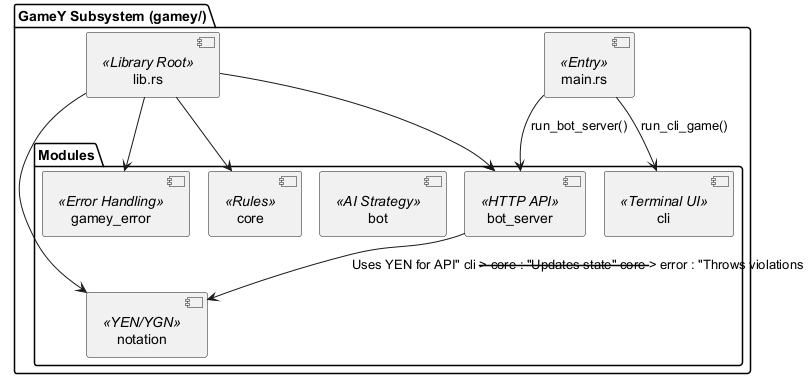
The GameY Engine is a high-performance Rust subsystem responsible for the rules of the "Game of Y". It is structured as both a Library (lib.rs) for core logic and a Binary (main.rs) that provides a Command-Line Interface (CLI) and an HTTP Bot Server.
5.3.1. Component Descriptions
| Module | Detailed Responsibility |
|---|---|
main.rs |
Application Entry Point. Uses clap to parse CLI arguments. It determines the execution mode: Human (local CLI), Computer (local vs Bot), or Server (HTTP API for the Webapp). |
lib.rs |
Library Root. The central exported interface. It organizes the crate into public modules and provides the high-level GameY struct used to manipulate the triangular board. |
core |
The Rules Engine. Implements the triangular board mathematics, coordinate systems (Barycentric/Index), and the connection-based win conditions. |
bot_server |
The Gateway. Uses tokio to run an asynchronous HTTP server. It allows the Webapp to request moves via REST, serving as the bridge between the React frontend and the Rust logic. |
bot |
The Intelligence. Contains three AI implementations: easy_level_bot (greedy one-step evaluator), gamer_bot (Minimax), and evil_bot (Monte Carlo Tree Search). All bots are managed and retrieved via the YBotRegistry. |
notation |
The Interoperability Layer. Implements YEN (Y Exchange Notation). It defines a JSON-serializable format for board layouts (e.g., "B/BR/.R."), inspired by chess’s FEN. |
cli |
Interactive Shell. Provides a rich terminal experience using rustyline. It supports board rendering, move history, and saving/loading game states to files. |
gamey_error |
Domain Safety. Defines the GameYError enum using thiserror. It strictly enforces game rules (e.g., Occupied, InvalidPlayerTurn) and ensures system resilience. |
5.3.2. Internal dynamics and logic
The GameY module operates through distinct execution patterns:
-
Stateful CLI Loop: In cli.rs, the run_cli_game function maintains an interactive loop. It captures user indices (e.g., "5"), converts them to coordinates, and applies moves to the GameY state. It supports "meta-commands" like save, load, and show_coords.
-
Stateless Server Pattern: When running in Mode::Server, the engine becomes a stateless API. It receives a YEN payload from the Webapp, reconstructs the game state momentarily in memory, calculates the AI’s response via the bot module, and returns the new state.
-
Strict Error Enforcement: Every action passes through the gamey_error module. If a player (or the Webapp) attempts an illegal move (such as placing a piece on an Occupied cell), the engine returns a specific error variant rather than allowing an inconsistent game state.
-
Serialization (YEN): The notation/yen.rs module ensures that complex triangular board states can be compressed into a single string. This is critical for the "Building Block" connection between the Webapp and GameY, as it minimizes the data payload sent over HTTP.
5.4. Level 2: User Service (Port 3000)
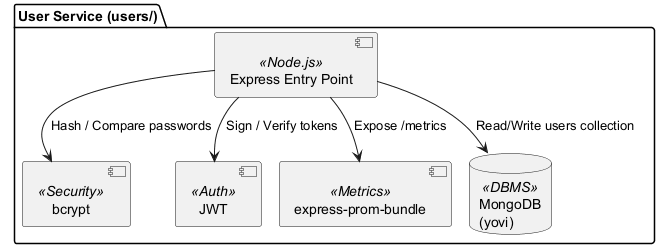
The User Service is a Node.js/Express application responsible for user identity management. It handles registration, login, password hashing, and JWT token generation.
5.4.1. Component Responsibilities
| Component | Technology | Responsibility |
|---|---|---|
Express Entry Point |
Node.js / Express 4.x |
Orchestrates |
Security Manager |
bcrypt |
Hashes passwords at cost factor 10 before persistence. Verifies submitted passwords against stored hashes on login. |
Auth Manager |
jsonwebtoken |
Signs JWT tokens containing |
Database Driver |
MongoDB Driver 7.x |
Handles asynchronous communication with the |
Metrics Provider |
express-prom-bundle |
Exposes |
5.5. Level 2: GameY API Gateway (Port 3001)
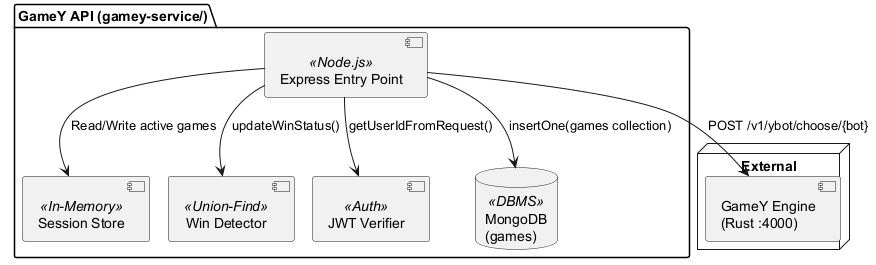
The GameY API Gateway is a Node.js/Express service that orchestrates active game sessions, routes moves to the Rust engine, handles win detection, and persists completed games to MongoDB.
5.5.1. Component Responsibilities
| Component | Technology | Responsibility |
|---|---|---|
Express Entry Point |
Node.js / Express 4.x |
Orchestrates all game routes: |
Session Store |
In-Memory Map |
Stores active game sessions. Sessions are lost if the process restarts unexpectedly. |
Win Detector |
Union-Find (JavaScript) |
|
JWT Verifier |
jsonwebtoken |
|
Database Driver |
MongoDB Driver 7.x |
Persists completed game results to the |
6. Runtime View
This section describes the dynamic behavior of GAME Y. It illustrates how the decomposed building blocks cooperate to fulfill key user scenarios based on the implemented REST endpoints.
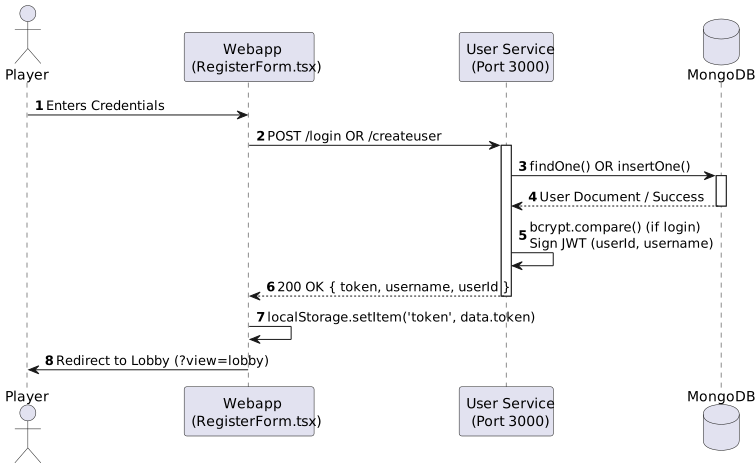
6.1. Scenario 1: User Authentication (Login & Registration)
Description: The entry point where a user creates an account or authenticates via the RegisterForm.
Trigger: User submits credentials. The component determines the endpoint based on the mode state ('login' or 'register').
Endpoint(s): POST :3000/createuser or POST :3000/login.
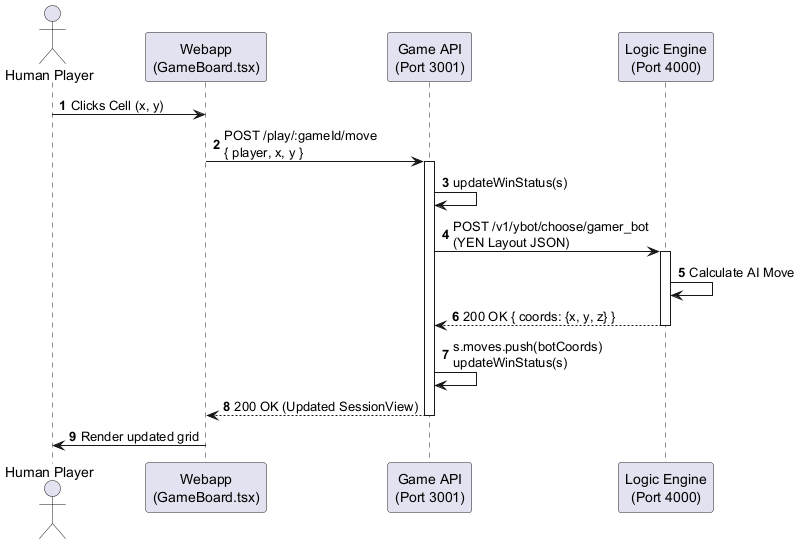
6.2. Scenario 2: Human Player vs. Bot (Game Loop)
Description: Orchestrating a move in "Human vs Bot" (hvb) mode.
Trigger: Player clicks a cell on the GameBoard.
Endpoint(s): POST :3001/play/:gameId/move and internal proxy to POST :4000/v1/ybot/choose/:bot_id.
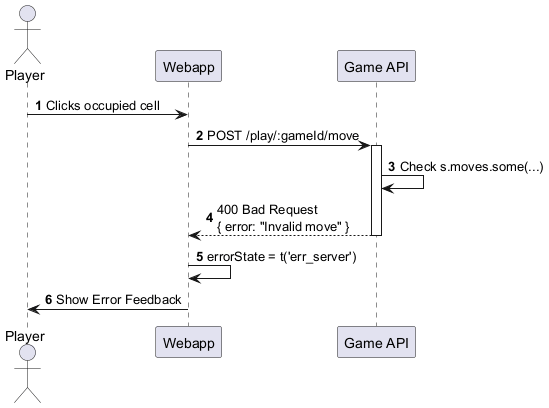
6.3. Scenario 3: Exception Handling (Invalid Move)
Description: Handling illegal moves (e.g., clicking an occupied cell or playing out of turn).
Trigger: User attempts an invalid action.
Endpoint(s): POST :3001/play/:gameId/move.
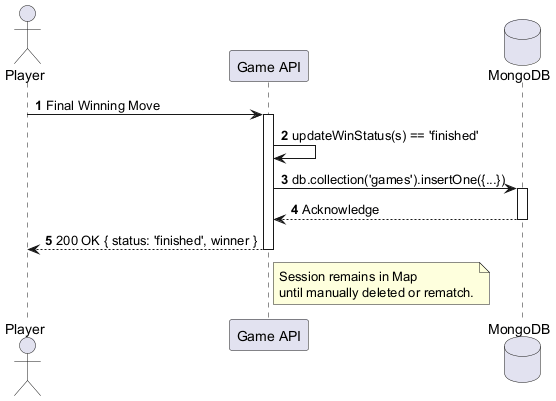
6.4. Scenario 4: Match Conclusion and Statistics Persistence
Description: Saving game results to the permanent match history upon completion.
Trigger: updateWinStatus(s) sets state to 'finished'.
Endpoint(s): Internal call to saveGameResult(session).
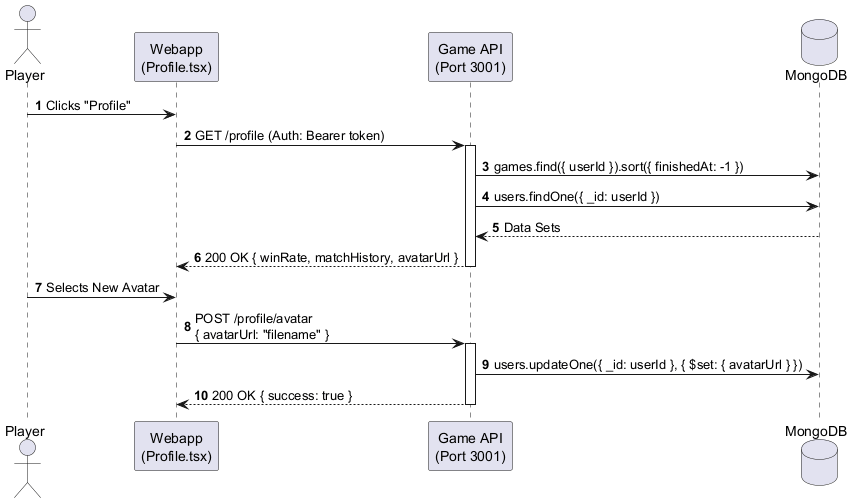
6.5. Scenario 5: Profile & Avatar Management
Description: Fetching match history and updating user personalization.
Trigger: User navigates to ?view=profile or selects a new avatar.
Endpoint(s): GET :3001/profile and POST :3001/profile/avatar.
7. Deployment View
7.1. Infrastructure Level 1: Azure Cloud Environment
7.1.1. Motivation
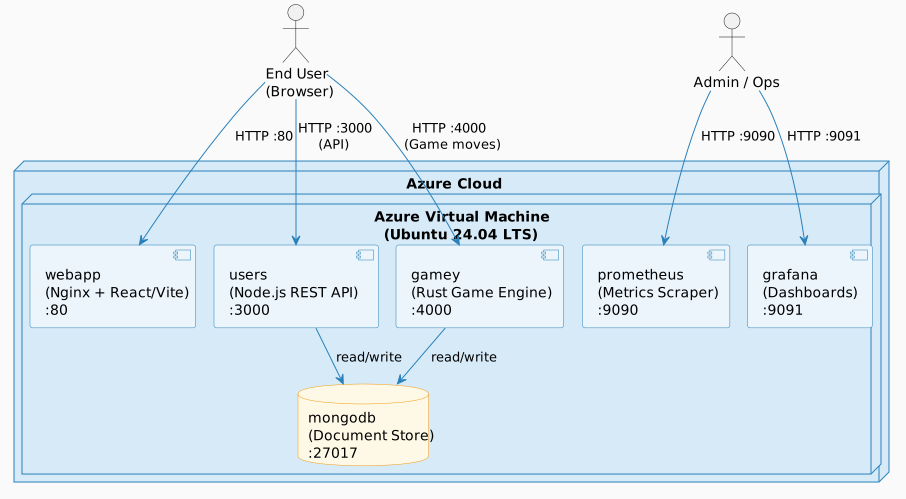
The system runs on a single Azure Virtual Machine (Ubuntu 24.04 LTS). Azure was chosen for its reliability and straightforward VM provisioning. A single VM keeps costs low while still resembling a real production environment. All components are containerised with Docker and orchestrated via Docker Compose, ensuring identical behaviour in development and production. Deployments are automated through GitHub Actions, pulling pre-built images from the GitHub Container Registry (ghcr.io/arquisoft/yovi_en1a).
7.2. Infrastructure Level 2: Container Orchestration (Docker Compose)
7.2.1. Motivation
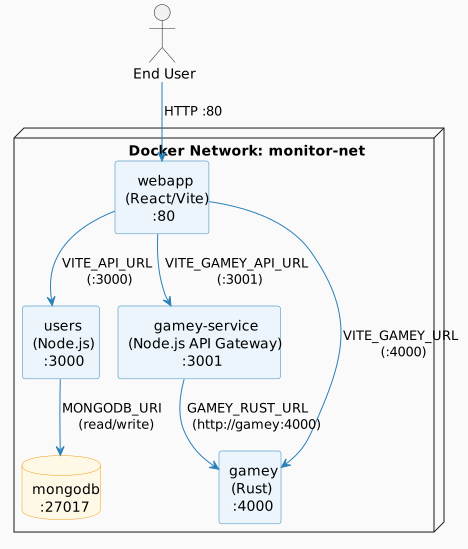
Docker Compose manages all containers in a single configuration file. All services run on a shared internal bridge network (monitor-net) so they can communicate without exposing unnecessary ports. Container images are pulled from the GitHub Container Registry.
The webapp receives backend URLs at build time via Vite environment variables (VITE_API_URL, VITE_GAMEY_URL, VITE_GAMEY_API_URL). The gamey-service Node.js gateway acts as an intermediary between the webapp and the Rust gamey engine, handling protocol and API translation. MongoDB includes a health check so dependent services only start once the database is ready.
7.2.2. Level 2a: Application Services
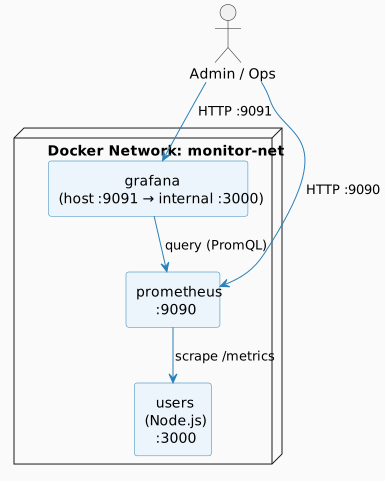
7.2.3. Level 2b: Observability Stack
7.3. Mapping of Building Blocks to Infrastructure
| Building Block | Infrastructure Element | Description |
|---|---|---|
webapp |
Docker Container (React/Vite) |
Serves the compiled frontend. Accessible on Port 80. Backend URLs are baked in at build time via Vite env vars. |
users |
Docker Container (Node.js) |
Handles identity, match history, and stats. Accessible on Port 3000. Requires MongoDB to be healthy before starting. |
gamey-service |
Docker Container (Node.js API Gateway) |
Intermediary gateway between the webapp and the Rust game engine. Accessible on Port 3001. Forwards requests to |
gamey |
Docker Container (Rust) |
Core game logic, move validation, and win detection. Accessible on Port 4000. |
mongodb |
Docker Container (MongoDB) |
Persistent document store for user profiles and match history. Includes a health check ( |
prometheus |
Docker Container (prom/prometheus) |
Scrapes metrics from |
grafana |
Docker Container (grafana/grafana) |
Visualises metrics from Prometheus. Internal port 3000 is mapped to host port 9091 to avoid conflict with the |
7.4. Infrastructure Level 3: Data Persistence
7.4.1. Motivation
Data must survive container restarts and redeployments. Prometheus and Grafana use bind mounts so their configuration lives directly in the repository and is version-controlled. MongoDB uses a named Docker volume so that user and game data persists independently of the container lifecycle.
| Element | Storage Strategy | Path / Volume |
|---|---|---|
Prometheus Config |
Docker Bind Mount |
|
Grafana Dashboards |
Docker Bind Mount |
|
User & Game Data |
Docker Named Volume ( |
Managed by Docker. Mounted at |
7.5. Network and Connectivity
All containers communicate over the monitor-net bridge network (Docker default bridge driver). The following ports are exposed to the host:
-
Port 80: Webapp entry point (React/Vite frontend).
-
Port 3000: Users REST API (consumed by webapp and external bots).
-
Port 3001: Gamey-service API Gateway (consumed by webapp).
-
Port 4000: Rust Game Engine (consumed by gamey-service and directly by webapp for real-time moves).
-
Port 27017: MongoDB - exposed to the host in port 27017.
-
Port 9090: Prometheus - metrics scraping and admin queries.
-
Port 9091: Grafana dashboards (remapped from internal port 3000).
7.5.1. Startup Dependencies
MongoDB must pass its health check (mongosh --eval "db.adminCommand('ping')", every 5 s, up to 5 retries) before the users service starts. The webapp waits for both users and gamey-service to be available. The gamey-service waits for gamey to be available.
8. Cross-cutting Concepts
8.1. Domain Concepts
8.1.1. Game Y and Hexagonal Grids
The core domain of the application revolves around the "Classic Version" of Game Y. The game environment is based on variable-sized hexagonal boards. The system supports multiple coordinate representations for these grids:
-
Barycentric Coordinates (x,y,z): Used to represent three-dimensional positioning in a 2D hexagonal space.
-
Index-based Coordinates (0…n): Linear representation for simpler indexing in arrays or matrices.
8.1.2. YEN Notation
All game states are uniformly formatted using the YEN Notation, which dictates how board sizes, player turns, and piece positions are serialized. This ensures consistent state representation across the Frontend, the Logic Engine, and external bots.
A YEN string encodes the complete game state in a compact, human-readable format. For example, on a 3×3 board where Blue has played two cells and Red has played one:
B/BR/.R.-
B— It is Blue’s turn. -
BR/— Row 1 contains a Blue piece, a Red piece, then the row separator. -
.R.— Row 2 contains an empty cell, a Red piece, and another empty cell.
8.1.3. Stateless Processing
The Logic Engine is intentionally stateless. Current game states (in JSON format) are passed within each request, allowing the engine to calculate AI behavior or determine win/loss states without storing active match sessions in memory.
8.1.4. State Management and Rendering
In the Frontend Webapp, complex match states and user actions are managed reactively.
-
State Trees: React manages the active game properties (board layout, opponent type, current turn) locally to provide instant visual feedback without blocking for server responses during non-validating actions.
-
Hexagonal UI Representation: The UI seamlessly maps the engine-provided mathematical coordinate arrays (Barycentric or Index-based) onto visual hexagonal grids for intuitive gameplay.
8.2. Security Concepts
8.2.1. Authentication and Password Storage
User identity is managed entirely by the User Service. On registration, passwords are hashed using bcrypt (cost factor 10) before being persisted to MongoDB. Plaintext passwords are never stored. On login, bcrypt.compare verifies the submitted password against the stored hash.
8.2.2. JWT-based Session Management
Upon successful login, the User Service issues a signed JSON Web Token (JWT). The React Webapp stores the token in the browser’s Session Storage and attaches it as an Authorization: Bearer <token> header on every subsequent API request. The User Service validates the token on all protected endpoints. The JWT_SECRET is managed via .env files locally and GitHub Secrets in production, ensuring it is never committed to source control.
8.2.3. CORS (Cross-Origin Resource Sharing)
Because the Webapp (Port 80) communicates with backend services on different ports (3000, 3001, 4000), CORS is configured explicitly on each service:
-
User Service (Node.js): Enforces a strict origin whitelist via the
corsmiddleware. Allowed origins are injected through theALLOWED_ORIGINSenvironment variable. Requests from unlisted origins are rejected. -
GameY API (
gameyapi): Currently uses a permissive CORS policy to facilitate external bot integration during development. This is identified as a known risk (see Section 11).
8.3. Communication and Integration Concepts
8.3.1. RESTful JSON APIs
Communication both internally (between subsystems) and externally (third-party bots) relies fully on HTTP REST APIs utilizing JSON.
-
Internal APIs: The User Service and Logic Engine communicate with the Webapp using predefined JSON schemas strictly validating YEN notation.
-
External Bot Interface: The system provides dedicated endpoints (e.g., a
playmethod) for third-party bots to interact with the engine.
8.3.2. Observability and Monitoring
To satisfy availability evaluation metrics, the system incorporates rigorous operational monitoring:
-
Metrics Ingestion: Both the Node.js API and the Rust Gamey Engine emit structured operational metrics.
-
Visualization: Prometheus scrapes system health, latency, and throughput metrics, which are then aggregated and visualized using Grafana dashboards.
8.3.3. Testing and Quality Assurance
System reliability is continuously verified through multiple layers of testing:
-
Multi-Layer Testing: The system utilizes unit tests for individual algorithmic checks (especially Rust logic), integration tests for API endpoints, and End-to-End (E2E) UI tests for critical user journeys.
-
Static Analysis: Code quality and security are strictly evaluated via SonarCloud against defined Quality Gates prior to any merge.
8.3.4. Continuous Integration and Deployment (CI/CD)
The development pipeline is automated natively with GitHub Actions:
-
CI Pipelines: Push events and pull requests trigger automated test suites and SonarCloud evaluations.
-
CD Pipelines: Upon a successful release merge, Docker images are automatically built from each service’s
Dockerfileand orchestrated on the production server viadocker-compose(see Sections 2 and 7 for the containerization details).
8.4. Development and Operational Concepts
8.4.1. Internationalization (i18n)
The React Webapp supports multiple languages via react-i18next. All user-facing strings are extracted into locale-specific JSON files, and components reference translation keys rather than hardcoded text. English acts as the fallback locale when a translation key is missing. This decouples the translation process from the codebase, allowing locale files to be updated independently of the application logic.
8.4.2. Documentation Strategy
The architecture documentation follows a strict Docs-as-Code approach:
-
AsciiDoc & Arc42: All architectural documentation is written in AsciiDoc, structured entirely according to the arc42 template. This approach ensures technical documentation lives alongside the source code in version control.
-
PlantUML: As dictated by our conventions, all architectural diagrams and models must comply with UML standards and are rendered programmatically using PlantUML.
8.4.3. Collaboration and Source Control
-
Git Workflows: Employs pull requests, mandatory code reviews, and issue tracking.
-
Traceability: Documentation must constantly be maintained following the arc42 structure (including ADRs) to comply with academic quality evaluation criteria.
9. Architecture Decisions
This section contains the most important architectural decisions made during the development of the Yovi (Game Y) application. The decisions are documented as lightweight Architecture Decision Records (ADR). Each decision outlines the context, the chosen solution, considered alternatives, and the resulting consequences.
9.1. ADR: MongoDB as DBMS
We need a database for the game backend to store player data, game sessions, and other game-related entities. The data model is expected to evolve during development.
We decided to use MongoDB as our primary Database Management System (DBMS). Unlike relational databases such as MySQL, MongoDB uses a document model based on BSON/JSON-like structures. It integrates well with web applications and is suited for self-contained entities like players and game sessions.
The flexible schema of MongoDB makes it easier to adapt the data model and acts as a natural fit for our JSON-based web backends. The primary alternative, MySQL, was considered due to the team’s familiarity with it, but MongoDB’s schema flexibility was deemed more important. As a consequence, the team requires some time to learn MongoDB, and the system is less suited for complex relational queries compared to SQL databases.
9.2. ADR: Microsoft Azure as VM Host
The project requires a reliable and scalable environment to host the application and its associated services, primarily our Docker containers and Node.js instances. The chosen cloud provider needs to offer robust Virtual Machine management, global availability, and integration with DevOps workflows.
We selected Microsoft Azure (Azure Virtual Machines) to host our infrastructure. Azure provides seamless integration with GitHub Actions for our CI/CD pipelines and offers "Azure for Students" credits, which fits the constraints of our academic project. It also provides a web portal for monitoring VM health.
While alternatives like AWS (Amazon Web Services) and Google Cloud Platform (GCP) are prominent in the cloud landscape, standardizing on Azure simplifies our deployment pipeline without introducing a steeper learning curve regarding billing or disconnecting us from existing academic subscriptions. Using Azure still requires us to monitor credit usage and accept specific Azure CLI tools.
9.3. ADR: JWT Authentication
The application uses a microservices architecture (users-service and gameyapi). We need a secure, stateless method to share user identity across these boundaries without querying a central database for session validation on every API call.
We chose JSON Web Tokens (JWT) for authentication. Upon a successful login, the users-service generates a signed token containing the user’s ID and username. Secret management uses .env files locally and GitHub Secrets in production to protect the JWT_SECRET. Consumer services like gameyapi verify the token locally using this shared secret.
Session-based authentication was discarded because it requires centralized stores like Redis, which increases latency. Opaque tokens were bypassed because they require resource servers to constantly contact the authentication service. JWTs improve performance through localized verification and allow horizontal scalability. However, this introduces security risks if the secret is compromised, and prevents instantly revoking specific active sessions.
9.4. ADR: Gatling as Load Testing Tool
The game services must handle concurrent players without performance degradation. We require load tests that simulate realistic user flows crossing multiple microservices.
We selected Gatling for load testing. Gatling simulations are written in a Scala/Java Domain-Specific Language (DSL) and execute against our staging environment during CI pipelines. Pipelines fail automatically if p95 response times or error rates exceed agreed thresholds. Gatling generates HTML reports after execution.
While other tools like JMeter use an XML-heavy format that is difficult to version-control, and options like k6 do not leverage our team’s existing JVM expertise, choosing Gatling ensures simulations live directly in version control and robustly handle stateful user flows. The primary downside is the needed Scala ramp-up time for developers lacking JVM experience.
9.5. ADR: Behavior and End-to-End Testing with Cucumber
To validate that backend and API logics execute according to defined business rules, we required a testing framework capable of matching behavioral specifications to executable code.
We integrated Cucumber for our API-level and functional End-To-End (E2E) tests. Cucumber allows us to write tests using natural language formats (Given/When/Then), directly bridging specifications and code assertions. This ensures our APIs behave exactly as requested by stakeholders.
9.6. ADR: Playwright for Browser Automation and UI Testing
The application provides a web frontend managing registration, authentication, and gameplay. To ensure user interface flows behave correctly across varied browsers, we need an automated browser testing setup to complement our Cucumber scenarios.
We implemented Playwright as our frontend UI testing framework. Tests run in TypeScript against Chromium, Firefox, and WebKit to catch browser-specific rendering flaws. In scenarios where login is not tested, the JWT is injected directly to maintain execution speed.
Compared to tools like Selenium, which can be slower with excessive setup boilerplate, or Cypress, which is often tightly bound to Chromium and challenges cross-browser testing needs, Playwright effectively centralizes our test suite. It reduces flakiness through built-in auto-waiting mechanisms. The trade-off is the inherent fragility of UI tests and the extended CI execution times required for multiple browser engines.
9.7. ADR: bcrypt as Password Hashing Library
The users-service handles player registration and login. Passwords must be hashed securely to prevent raw credentials from being exposed in case of a database breach.
We standardized on bcrypt as the main library to hash and verify passwords. Passwords are hashed with salt and never persist as plain text. Upon login, bcrypt evaluates the injected password against the stored hash before issuing a JWT.
Fast hashing algorithms like MD5 or SHA-256 without key stretching were disqualified because they are easily cracked by modern hardware. Argon2 was considered but passed over due to its smaller ecosystem in Node.js compared to bcrypt. While bcrypt’s scalable workload provides strong security, developers must use its asynchronous methods to prevent blocking the Node.js event loop.
9.8. ADR: i18n for Internationalization
The game aims to reach players across multiple language regions. Hardcoding strings into React components requires expensive refactoring later.
We integrated react-i18next as our internationalization framework early in development. All user-facing strings are extracted into locale-specific JSON files, allowing frontend code to reference descriptive translation keys. English acts as the fallback locale when a token is missing.
By avoiding hardcoded layouts, we uncoupled the translation process from the codebase. Translators can manage the JSON files independently. This requires strict discipline from the frontend team to extract new strings immediately and maintain organized key naming conventions.
9.9. ADR: gameyapi as Node.js REST API Service
The application needs a backend orchestration service to manage game sessions, route player moves to the bot engine, and store match results in the database.
We built the gameyapi as a Node.js REST API utilizing the Express framework. It communicates via JSON and trusts authenticated JWTs. The service stores ongoing game sessions in memory and only persists completed classic-mode games to MongoDB.
Python with FastAPI was considered for its async capabilities, but the team opted for Node.js to reuse JavaScript tooling and knowledge. A pure Rust solution was discarded because routing API traffic is faster to iterate on in JavaScript, while calculation burdens remain delegated to the Rust service. This design capitalizes on Node’s async I/O strengths, but risks losing active in-memory games if the Node process restarts unexpectedly.
10. Quality Requirements
10.1. Quality Tree
The following quality tree summarizes the most important quality goals and links them to the concrete scenarios described in the next section. Higher-priority goals are listed first.
| Quality Category | Sub-quality | Related Scenario(s) |
|---|---|---|
Security |
Authentication, data protection |
QS-01, QS-02 |
Performance |
Response time, throughput |
QS-03, QS-04 |
Usability |
Learnability, feedback clarity |
QS-05, QS-06 |
Reliability |
Availability, fault tolerance |
QS-07, QS-08 |
Maintainability |
Modifiability, testability |
QS-09, QS-10, QS-11 |
10.2. Quality Scenarios
10.2.1. QS-01: Unauthorized users cannot access protected resources
Source |
Unauthenticated or malicious external actor |
Stimulus |
Attempt to access player data or game state via the API without a valid JWT token |
Environment |
Any environment, including production |
Artifact |
API authentication layer in the User Service and GameY API Gateway |
Response |
The request is rejected with HTTP 401 or 403 |
Response Measure |
Zero successful unauthorized accesses to protected endpoints, verified by unit and integration tests covering JWT validation and CORS origin filtering |
Evidence: Section 12.1 confirms the authentication lifecycle is tested, covering JWT issuance, bcrypt hashing, and strict CORS origin filtering.
10.2.2. QS-02: Passwords and sensitive data are stored securely
Source |
Developer or database administrator inspecting the database |
Stimulus |
Inspection of stored user credentials in MongoDB |
Environment |
Any environment where user accounts exist |
Artifact |
User Service persistence layer |
Response |
No plaintext passwords or sensitive tokens are found in storage |
Response Measure |
All passwords are hashed with bcrypt (cost factor 10); no plaintext credentials exist in any collection or log, verified by automated tests |
Evidence: Section 12.1 explicitly tests bcrypt password hashing and confirms no plaintext storage.
10.2.3. QS-03: System handles peak concurrent load
Source |
Multiple players starting game sessions simultaneously |
Stimulus |
Up to 150 concurrent users interacting with the application across signup and game move flows |
Environment |
Peak usage period, tested against the deployed Azure environment |
Artifact |
User Service, GameY API Gateway, and Rust Engine |
Response |
All requests are processed without errors; no board state is lost or corrupted |
Response Measure |
Error rate stays at 0% (0 KO responses); p95 response time stays below 2 seconds, validated by Gatling load tests ramping from 0 to 15 rps across 7 progressive phases |
Evidence: Section 12.4 describes Gatling load tests with 0 KO results. The updated injection profile ramps up to 15 rps sustained, reaching approximately 100-150 concurrent users at peak.
10.2.4. QS-04: Board updates are reflected within acceptable response time
Source |
Player submitting a move during a game session against the AI |
Stimulus |
A player places a tile; the move is sent to the GameY API Gateway, forwarded to the Rust Engine, and the updated state is returned |
Environment |
System under normal load, Player-vs-AI mode |
Artifact |
GameY API Gateway and Rust Engine |
Response |
The updated board state is returned to the frontend and rendered |
Response Measure |
Response time for move validation and AI calculation stays below 2 seconds in 95% of cases, consistent with load test results from Section 12.4 |
Note: Real-time push (WebSockets) is not yet implemented. This scenario covers the current REST-based flow only. The Human vs Human multiplayer real-time scenario is tracked as a technical debt in Section 11.
10.2.5. QS-05: New user can start a game without prior instructions
Source |
First-time user with no prior knowledge of the system |
Stimulus |
User opens the application and attempts to register, start a game, and place their first tile |
Environment |
Standard browser, no tutorial shown beforehand |
Artifact |
Frontend UI and onboarding flow |
Response |
The user completes registration, finds the game lobby, and successfully places their first tile |
Response Measure |
At least 80% of test users place their first tile within 3 minutes without external help, validated by usability testing |
Evidence: Section 12.3 usability tests show all 5 participants completed the full task flow. The reference user (CK=10) completed in 73 seconds; average completion was approximately 133 seconds, well within the 3-minute threshold.
10.2.6. QS-06: Player receives clear feedback when a tile placement is invalid
Source |
Player during an active game session |
Stimulus |
Player attempts to place a tile on an already occupied cell |
Environment |
Normal gameplay, Player-vs-AI mode |
Artifact |
Frontend validation layer and GameY Engine error propagation |
Response |
The invalid placement is visually indicated; no raw error message or silent failure occurs |
Response Measure |
Feedback is shown within 200 milliseconds of the attempt; verified by E2E tests covering the invalid move scenario (Section 6.5) |
Evidence: Section 12.1 and 12.2 confirm error handling is tested end-to-end, including the Rust engine returning 400 Bad Request and the frontend rendering appropriate feedback.
10.2.7. QS-07: Application is available during expected usage hours
Source |
End users accessing the system at any time |
Stimulus |
User attempts to access the application |
Environment |
Non-maintenance period, standard operating conditions on the Azure VM |
Artifact |
Deployment infrastructure, Docker Compose orchestration, and Prometheus/Grafana monitoring stack |
Response |
The application loads and is fully functional |
Response Measure |
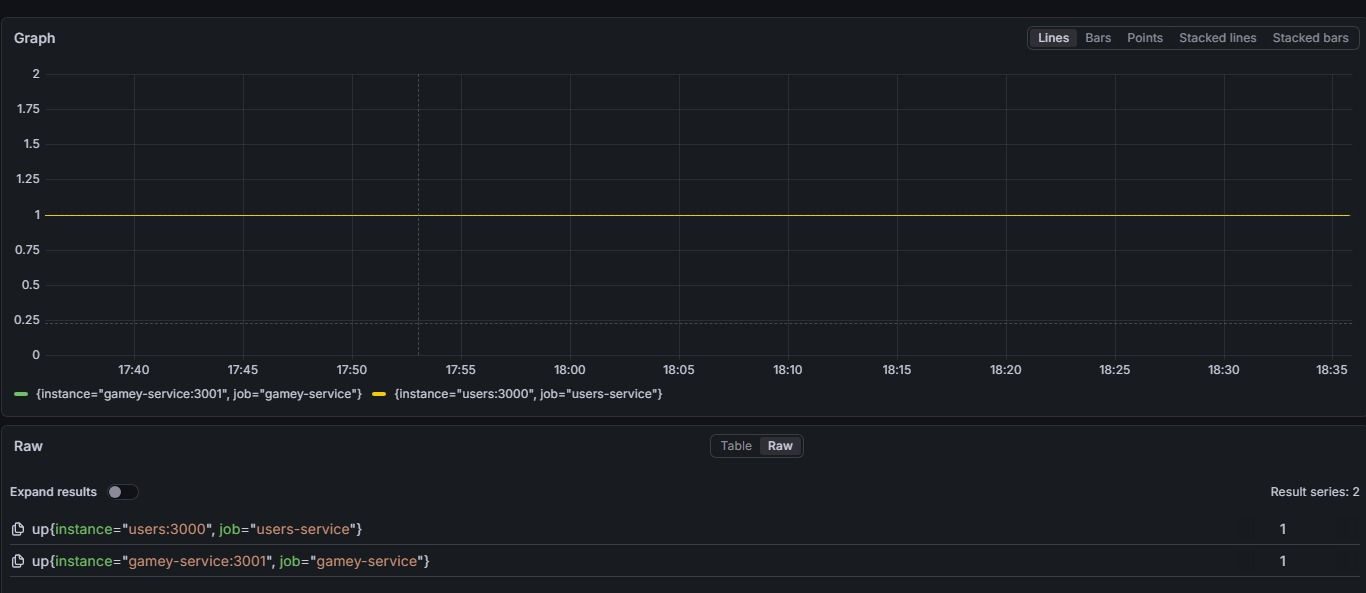
System availability is at least 99% measured monthly, excluding scheduled maintenance windows; monitored continuously via Prometheus and visualized in Grafana dashboards. |
Currently, our Grafana states that both of our services have always been available:
10.2.8. QS-08: System recovers gracefully from database connectivity issues
Source |
Infrastructure failure or transient network issue |
Stimulus |
MongoDB becomes temporarily unreachable during active user requests |
Environment |
Production environment, any load level |
Artifact |
User Service Health Guard middleware |
Response |
The system handles the disconnection gracefully without crashing; retries are attempted automatically and the user receives an appropriate error response |
Response Measure |
No unhandled crashes occur on MongoNotConnectedError; automatic retry logic is triggered, verified by unit tests covering the Health Guard middleware |
Evidence: Section 12.1 explicitly tests the Health Guard middleware for database disconnects and MongoNotConnectedError retry logic.
10.2.9. QS-09: A developer can add a new AI strategy with limited effort
Source |
Developer extending the system |
Stimulus |
A new AI move-generation strategy needs to be added to the GameY Engine |
Environment |
Development environment, working codebase |
Artifact |
Rust bot module and YBotRegistry |
Response |
The new strategy is available for selection via the API and UI without modifying other subsystems |
Response Measure |
The change requires modifications in no more than 3 files within the bot module and can be completed in under 2 hours by a developer familiar with the codebase |
10.2.10. QS-10: The test suite covers critical game logic
Source |
Development team running the CI pipeline |
Stimulus |
A pull request is submitted with changes to board or move validation logic |
Environment |
Automated CI environment with GitHub Actions |
Artifact |
Unit and integration test suite across Rust, Node.js, and React |
Response |
The pipeline runs all relevant tests and reports pass or fail clearly |
Response Measure |
Code coverage for core game logic modules is at least 80%; the CI pipeline completes within acceptable time, enforced by SonarCloud quality gates on every pull request |
Evidence: Section 12.1 confirms >80% coverage is maintained across critical paths including move validation, session security, and database connectivity.
10.2.11. QS-11: The application supports multiple languages without code changes
Source |
Developer adding a new locale or translator updating existing strings |
Stimulus |
A new language file is added or an existing translation key is updated |
Environment |
Development environment |
Artifact |
React frontend and react-i18next locale JSON files |
Response |
The new or updated language is reflected across all user-facing strings without modifying any React component code |
Response Measure |
All user-facing strings are managed exclusively through locale JSON files; English fallback is applied automatically for missing keys; verified by localization integration tests |
Evidence: Section 12.1 confirms react-i18next integration is tested, including multilingual support and translation key resolution.
11. Risks and Technical Debts
The following table lists the identified technical risks and technical debts within the YOVI_0 architecture. A Risk describes a potential future problem (e.g., security vulnerabilities or system overload), while a Technical Debt represents incomplete implementations or shortcuts taken during development that need to be refactored before a production release. The items are ordered by their priority and potential impact on the system.
| Priority | Type | Name & Description | Mitigation Strategy / Next Steps |
|---|---|---|---|
High |
Risk |
Missing Rate Limiting on Public API |
Implement rate-limiting middleware (e.g., |
High |
Risk |
Permissive CORS Policy |
Tighten the CORS configuration by implementing a strict origin whitelist for the GameY API, similar to the |
Medium |
Debt |
Runtime Secrets Management |
Migrate the runtime environment to use native Docker Secrets or a vault-based solution for the production hardening phase, ensuring secrets are never exposed in plain text on the host filesystem. |
Medium |
Debt |
Lack of Real-time Push (WebSockets) |
Integrate WebSockets (e.g., via Socket.IO) into the User Service to actively push game state updates directly to connected React clients. |
Low |
Debt |
Decentralized Logging |
Deploy a centralized log aggregation stack (e.g., shipping Docker logs to Loki, integrated with the existing Grafana setup) in a future iteration. |
12. Testing
This section describes the testing strategy, the technologies utilized, and the improvements made to the application based on the results obtained during the development lifecycle.
12.1. Unit and Integration Testing
Our testing strategy focuses on verifying the reliability of both the internal logic and the interaction between microservices. We employ a "bottom-up" approach, moving from isolated utility functions to full API endpoint validation.
-
Technologies:
-
Vitest: Used as the modern, high-performance test runner for both the React frontend and the Node.js microservices.
-
React Testing Library & user-event: Employed to validate UI components by simulating authentic user behavior and ensuring accessibility through ARIA role-based queries.
-
Supertest: Utilized for black-box testing of REST API endpoints, verifying HTTP response codes and JSON payloads.
-
MongoDB Memory Server: Used to provide isolated, ephemeral database instances for every test suite, ensuring zero side effects between test runs.
-
-
Results and Verification:
-
Core Game Mechanics: We maintained high coverage of the hexagonal grid logic, specifically verifying cell state transitions, coordinate mapping, and winning path calculations.
-
Infrastructure Resiliency: Tests verify the "Health Guard" middleware, ensuring the system can handle database disconnects and execute automatic retries for
MongoNotConnectedErrorwithout impacting the user experience. -
Identity & Security: The authentication lifecycle was rigorously tested, covering
bcryptpassword hashing, JWT issuance, and strict CORS origin filtering to prevent unauthorized cross-site requests. -
Personalization & Localization: Verified the integration of
react-i18nextfor multilingual support and the secure handling of user profile updates (e.g., avatar selection) via authenticated API calls.
-
|
Note
|
By prioritizing critical paths—such as move validation, session security, and database connectivity—we maintained a code coverage target of >80%, ensuring that core functionalities remain stable as the architecture scales. |
12.2. Acceptance Testing (E2E)
Acceptance testing ensures the application fulfills the business requirements by simulating real user behavior across different environments.
-
Technologies:
-
Cucumber.js: For defining test scenarios in Gherkin syntax, providing a bridge between technical implementation and functional requirements.
-
Playwright: Chosen for its superior speed and native support for modern web features.
-
Cross-Browser: Tests are executed across Chromium, Firefox, and WebKit to ensure UI consistency.
-
-
Results:
-
3-Games E2E Macro: We successfully automated the complete user journey: Registration → Playing 3 matches on varying difficulties → Verifying the "WINS!" UI popup → Validating Profile Statistics updates → Logout.
-
CI/CD Integration: Automated checks are now triggered on every Pull Request and prior to each release, ensuring zero regressions in core features.
-
12.3. Usability Testing
To evaluate if the application is intuitive and identify visual or flow weaknesses, we conducted a moderated usability test with external users.
12.3.1. Methodology
The test was conducted as an "at-home" experience. Users were given specific tasks without any guidance to observe natural interaction. We utilized the "Think Aloud" protocol, where participants narrated their thoughts and frustrations in real-time.
-
Privacy: No personal data (names, IDs) was recorded to ensure complete anonymity.
-
Participant Profiles: A single batch of 5 users was selected with varying ages, genders, and Computer Knowledge (CK) on a scale of 0-10.
-
The Ideal Scenario (Benchmark): Within the batch, one user was assigned a CK of 10 (Software Student/Professional). This user serves as the ideal scenario, representing the best possible interaction time and providing a reference point for the maximum efficiency of the current UI.
-
Tasks Performed:
-
Register a new account or Log In.
-
Complete a game session on Medium Difficulty.
-
Locate and review personal statistics in the Profile section.
-
12.3.2. Test Results (Batch Report)
The following metrics were captured during the session with 5 participants:
Age |
Gender |
CK (0-10) |
Time (sec) |
Completed? |
Grade (0-10) |
21 |
M |
10 (Ref) |
73 |
Yes |
8 |
63 |
M |
3 |
245 |
Yes |
8 |
58 |
F |
8 |
110 |
Yes |
9 |
31 |
F |
7 |
95 |
Yes |
8 |
34 |
M |
5 |
142 |
Yes |
9 |
-
Average Age: 41.4 years.
-
Gender Ratio: 60% Male / 40% Female.
-
Average Time by Gender: Male: 153.3s | Female: 102.5s.
-
Average Time by Age Group:
-
[20-30]: 73s
-
[30-40]: 118.5s
-
[50-65]: 177.5s
-
-
Overall Application Grade: 8.4 / 10
12.3.3. Conclusions and Observations
-
Benchmark Comparison: By comparing the 'normal' users against our CK 10 (Ideal Scenario), we identified that the primary time difference occurred during the registration phase and navigation to the statistics page. The ideal scenario took only 73 seconds, while the average user took approximately double that time.
-
Demographic Patterns: While our oldest user (63) successfully completed the test and gave a high grade, their completion time (245s) was significantly higher than the benchmark. This confirms that navigation flow needs to be more explicit for those with lower CK, as users in higher age brackets are more prone to hesitation or frustration when UI cues are purely iconographic.
-
Efficiency vs. Satisfaction: Interestingly, despite the variations in time taken, the grades remained consistently high (8-9). This suggests that the core game is engaging, but the friction lies in the secondary interface elements (Lobby and Profile navigation).
-
Direct Observations: During the "Think Aloud" sessions, we observed users hovering over the navbar looking for the "How to Play" section and hesitating at the Lobby screen because the "Start Game" button did not visually stand out as the primary action.
12.3.4. Proposed Changes (Future Versions)
Based on the feedback and observations from our test batch, the following improvements are proposed for future releases to enhance clarity and streamline the user flow:
-
Lobby Logic Optimization: Currently, game difficulty settings remain visible in the lobby regardless of the selected mode. We propose hiding these settings unless the PvC (Player vs Computer) mode is active, as they do not apply to other modes and cause confusion for new users.
-
Explicit Help Navigation: The "How to Play" section is currently represented only by a
?icon in the navbar. To improve discoverability for users with lower computer dexterity, we propose adding an explicit "How to Play" label next to the icon or implementing a "First-time user" guided tour. -
Game Start Visibility: Users noted that the "Start Game" button is too visually similar to other interface elements, leading to delays in beginning the match. We propose two possible solutions:
-
Option A: Redesign the button with a high-contrast "Call to Action" (CTA) style to make it stand out.
-
Option B: Implement an automatic start sequence once all parameters are selected, removing the extra click entirely.
-
-
Accessibility: Increase font sizes and improve color contrast to better accommodate users in higher age brackets who struggled with small text.
12.4. Load Testing
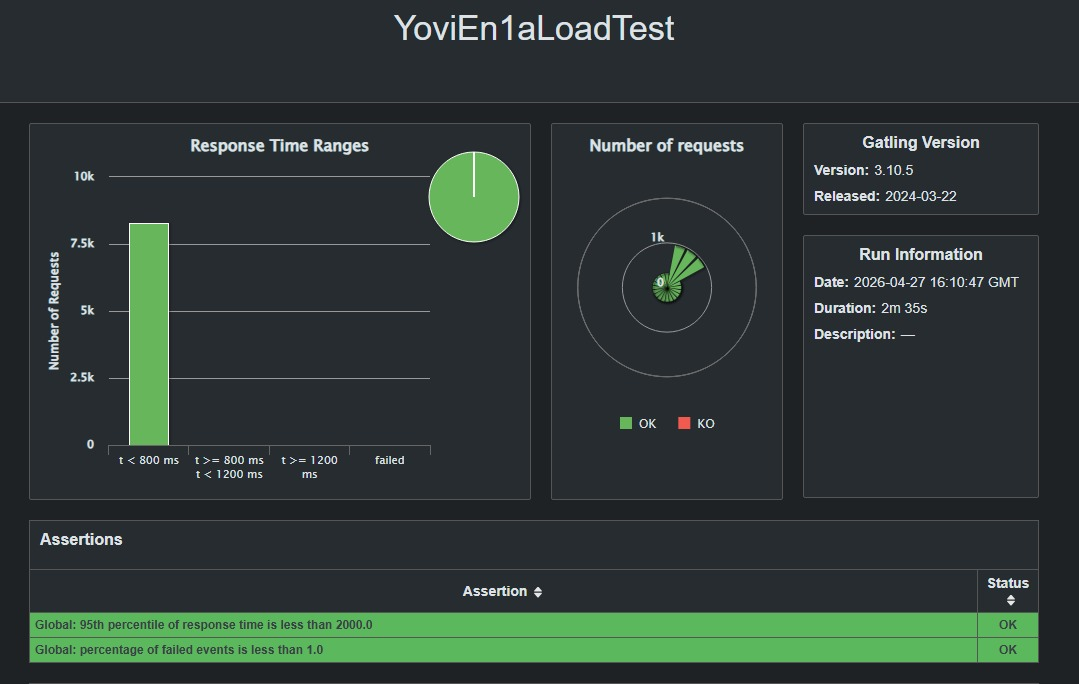
We use Gatling (bundle, version 3.10.5) to implement load tests over our deployed application. The signup functionality, which creates users from the users service API was tested, along with the game service, which checks multiple moves in the board of GameY.
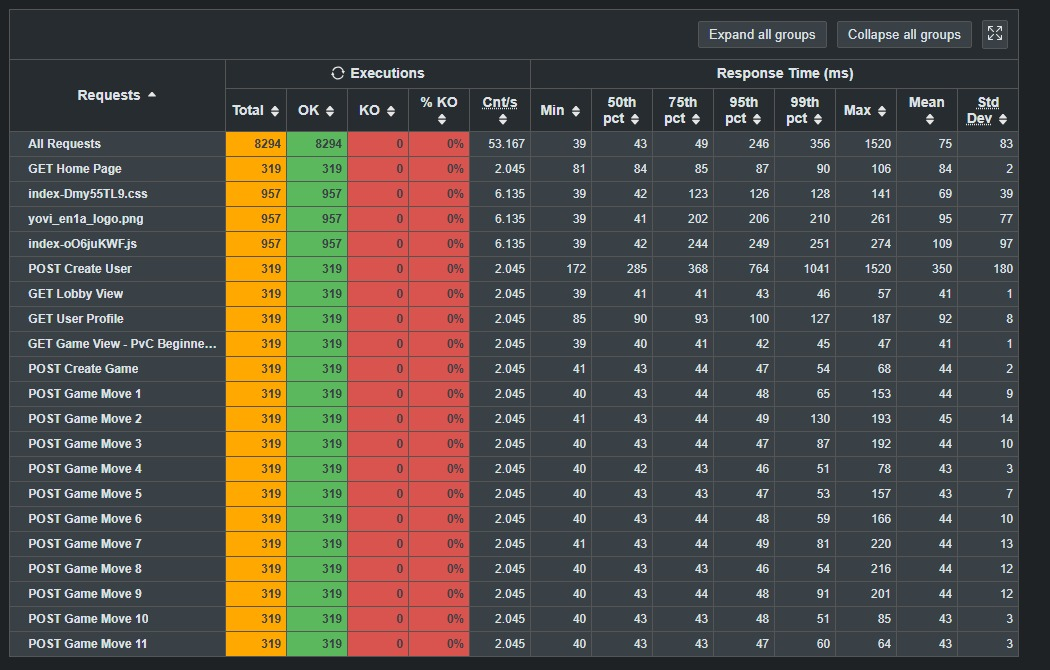
In order to record the requests, we used the recorder script. Using Mozilla Firefox and configuring a proxy for localhost’s port 8000, we record interactions with the app (signup, moves in board,) and they are recorded in request file in resources. Simulation file YoviEn1aLoadTest.java is generated as well.
We modify the simulation for managing 100-150 randomized users interacting with the application at once. Approximately, we send 330 requests to the system at once, at it can manage it. After executing, we get 0 KO messages and this results, showing a good management of a bigger user quantity:
13. Glossary
| Term | Definition |
|---|---|
ADR |
Architectural Decision Record - a document capturing an important architectural decision, its context, consequences, and rationale. |
AI |
Artificial Intelligence - the computer-controlled opponent in the game. |
arc42 |
A template for documenting software and system architectures, used as the foundation for this documentation. |
Barycentric Coordinates |
A coordinate system for hexagonal grids using three coordinates (x, y, z) that sum to zero. Used in the game to represent cell positions. |
Classic Version |
The variant of Game Y implemented in this project, following the standard rules of the game. |
CORS |
Cross-Origin Resource Sharing - a security mechanism that allows a web page to access resources from a different origin. |
Cucumber.js |
A tool for running automated tests written in plain language (Gherkin), used for the project’s Acceptance Testing. |
Docker |
A containerization platform used to package and run the application services consistently across environments. |
FR |
Functional Requirement - a requirement that specifies a function the system must perform. |
Game Y |
The core game implemented in the project - a connection-based board game played on a triangular grid of hexagonal cells. |
GameY Engine |
The Rust‑based subsystem that contains the game logic, move validation, win detection, and AI move generation. |
GameY API |
The Node.js‑based API Gateway that routes moves and YEN payloads between the Webapp (or external bots) and the Rust Logic Engine. |
Gherkin |
A domain-specific language for defining test scenarios using Given/When/Then syntax, making technical tests readable for stakeholders. |
Grafana |
An observability platform used to visualize metrics collected by Prometheus. |
Index-based Coordinates |
A linear coordinate system (0…n) for simpler indexing of board cells, used as an alternative to barycentric coordinates. |
JSON |
JavaScript Object Notation - the data interchange format used for all communication between subsystems. |
JWT |
JSON Web Token - a compact, URL-safe token format used for authentication and session management (planned). |
Micrati |
A stakeholder group that expects a functional prototype meeting all success criteria. |
MongoDB |
A document‑oriented NoSQL database used to store user profiles and match histories. |
Node.js |
The JavaScript runtime used for the User Service. |
Playwright |
A cross-browser automation framework used for End-to-End (E2E) testing on Chromium, Firefox, and WebKit. |
PlantUML |
A tool for creating UML diagrams from plain text, used to generate all architectural diagrams in this documentation. |
Player‑vs‑Machine (AI) |
The game mode where a human player competes against the AI opponent. |
Prometheus |
A monitoring system that scrapes and stores metrics from the services. |
React |
The JavaScript library used to build the frontend web application (Webapp). |
REST |
Representational State Transfer - the architectural style used for the HTTP APIs between subsystems and external bots. |
Rust |
The programming language used for the GameY Engine, chosen for memory safety and performance. |
TypeScript |
The programming language used for the frontend (Webapp). |
User Service |
The Node.js‑based subsystem responsible for user registration, authentication, and persistence of statistics. |
Vitest |
A Vite-native testing framework used as the primary runner for unit and integration tests across the stack. |
Webapp |
The React frontend application that provides the user interface and orchestrates requests to the backend services. |
YEN Notation |
Y Exchange Notation - a compact, JSON‑based format for representing the complete game state (board size, player turn, piece positions). |
YOVI |
The name of the project and the game. |